Français

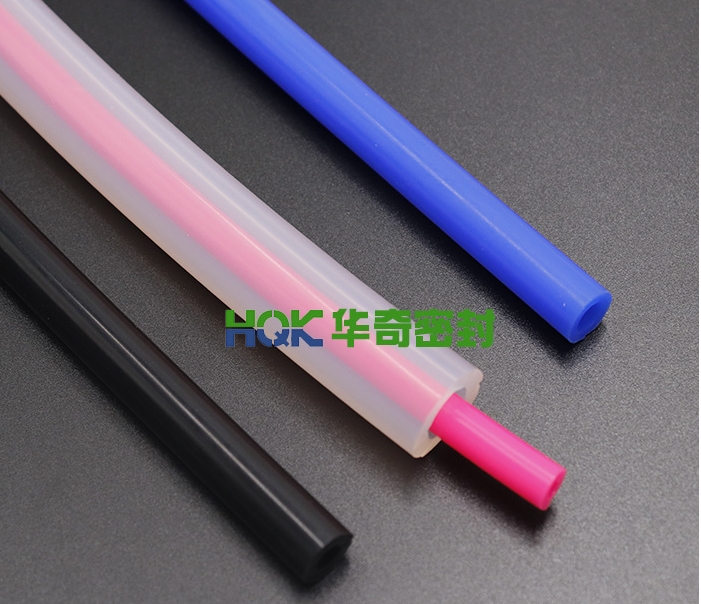
Unvulcanised rubber can be dissolved in solvents with similar solubility parameters. For vulcanised rubber, due to chemical cross-linking of rubber macromolecules into a three-dimensional network structure, it can only absorb solvent in the solvent to gradually expand and reach the equilibrium value (maximum swelling). This phenomenon is called "swelling" of rubber. The volume after swelling can be several times the volume of rubber. This is accompanied by a loss of mechanical strength. The maximum swelling of vulcanised rubber is related to its crosslink density. In the absorption of solvent, vulcanised rubber crosslinking network also swelled and produce the solvent will be extruded out of the network of elastic contraction force, when the solvent diffusion infiltration pressure and the crosslinking network of the elastic contraction force is equal, that is, to reach the swelling equilibrium.
As the depth of liquid immersion into the rubber is a function of the square root of the contact time, therefore, even if the rubber has no special impedance to the liquid in contact with, if the rubber parts themselves have a certain volume, but also to make it have a certain service life.
Swelling properties are one of the common characteristics of rubber or polymers. In some solvents, cross-linked rubber or other polymers generally do not dissolve, but the solvent molecules will enter into the polymer chain. However, the solvent molecules will enter into the polymer chain gap, increasing the volume between the chain, so the volume of the polymer due to expansion and swelling. General mechanical properties of rubber after swelling The mechanical properties of rubber generally decrease after swelling. Swelling is a very important property of rubber, so rubber should try to avoid contact with solvents of similar polarity.
As the depth of liquid immersion into the rubber is a function of the square root of the contact time, therefore, even if the rubber has no special impedance to the liquid in contact with, if the rubber parts themselves have a certain volume, but also to make it have a certain service life.
Swelling properties are one of the common characteristics of rubber or polymers. In some solvents, cross-linked rubber or other polymers generally do not dissolve, but the solvent molecules will enter into the polymer chain. However, the solvent molecules will enter into the polymer chain gap, increasing the volume between the chain, so the volume of the polymer due to expansion and swelling. General mechanical properties of rubber after swelling The mechanical properties of rubber generally decrease after swelling. Swelling is a very important property of rubber, so rubber should try to avoid contact with solvents of similar polarity.